
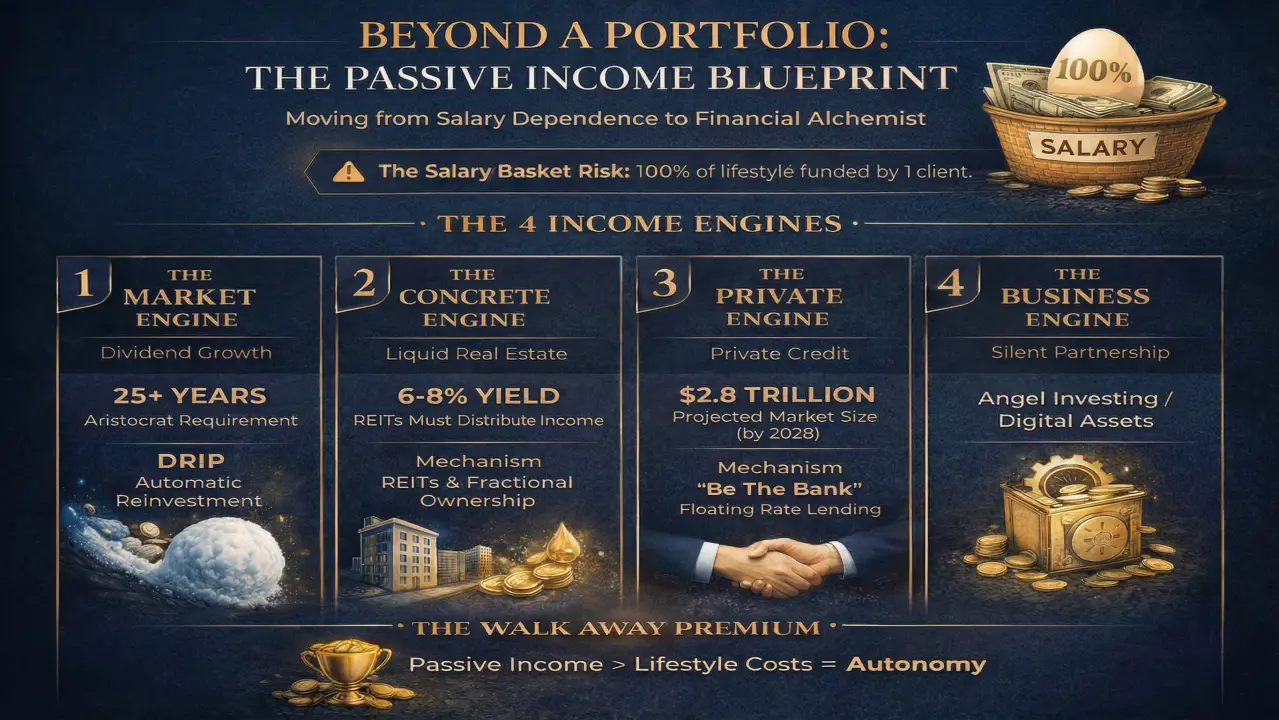
The Salary Basket Risk: Is Your Life Built on a Single Point of Failure?
If you are a high-performing executive, you understand risk management. You would never allow your company to rely on a single client for 100% of its revenue. That is a single point of failure, a structural weakness that keeps CEOs awake at night.
Yet, look at your personal balance sheet.
For most executives, 100% of their lifestyle is funded by a single client: their employer.
This is the Salary Basket Risk. No matter how high your income, if it comes from one source, your financial fortress is built on a foundation of sand. A restructuring, a market shift, or a health crisis can wipe out that income stream instantly, turning your high-quality lifestyle into a high-stress liability.
To move from a “High-Income Employee” to a “Wealth Alchemist,” you must shift your primary goal. Your objective is no longer just to increase your net worth (a vanity metric); it is to diversify your cash flow (a freedom metric).
Here is the blueprint for architecting a financial life where your freedom is not tied to your presence in the boardroom.
1. The Market Engine: The Dividend Snowball
The first layer of your fortress should be liquid, transparent, and completely passive. This is where Dividend Growth Investing comes in.
Too many executives chase “growth stocks” hoping for a lottery win. The Alchemist chases reliability.
- The Strategy: Focus on “Dividend Aristocrats” companies that have increased their payouts for 25+ years. These are businesses with wide moats and resilient cash flows.
- The Accelerator: Do not spend the dividends. Activate a Dividend Reinvestment Plan (DRIP). This automatically uses your payouts to buy more shares, which pay more dividends, which buy more shares.
- The Result: You create a “Snowball Effect” where your income grows exponentially, independent of your labor or the stock price volatility.
2. The Concrete Engine: Real Estate (Without the Headaches)
Real estate is a cornerstone of wealth, but for a busy executive, being a landlord is a second job you don’t have time for. You need the yield without the “toilets and tenants.”
- REITs (Real Estate Investment Trusts): Think of these as “liquid real estate.” They trade like stocks but own income-producing properties (data centers, healthcare facilities, logistics hubs). They are required by law to distribute 90% of their taxable income to shareholders.
- Fractional Ownership: Platforms now allow you to own a slice of institutional-grade commercial real estate or luxury holiday rentals. This offers higher potential yields than REITs and gives you specific asset exposure, but with professional management handling the operations.
The Rule: If you have to fix a leak, it’s not passive. It’s a job. Structure your real estate holdings so they pay you to own them, not to manage them.
3. The Private Engine: Private Credit & Lending
This is the asset class that separates the “Retail Investor” from the “Family Office.”
As traditional banks retreat from middle-market lending due to regulations, Private Credit has exploded (projected to reach $2.8 trillion by 2028).
- What it is: You effectively act as the bank, lending capital to established companies or real estate projects in exchange for regular interest payments.
- The Advantage: These loans often float with interest rates, offering protection against inflation, and typically yield significantly higher returns than traditional bonds or savings accounts.
- Access: Previously reserved for the ultra-wealthy, new structures and funds allow accredited investors to allocate capital to this sector.
4. The Business Engine: The “Silent” Partner
You don’t always need to start a business from scratch (like my import/export venture) to benefit from business income.
- Angel Investing / Silent Partnerships: If you have capital and industry expertise, you can back operators who have the time and energy to build. You provide the fuel; they provide the fire.
- Digital Assets: In the digital economy, owning intellectual property (a course, a patent, a specialized software tool) creates royalties that function like business income without daily operations.
The True North Integration
Building these streams isn’t just about “more money.” It is about Bandwidth Preservation.
The True North leader knows that wealth is a tool for autonomy. When your passive streams cover your mortgage and basic expenses, you gain “The Walk Away Premium.” You lead with conviction, not fear, because you know your survival isn’t tied to your monthly salary.
The Mandate: Stop trying to save your way to freedom. You cannot save fast enough to outrun inflation and lifestyle creep. You must build your way out.
Start with one engine. Master it. Then use the cash flow from the first to fund the second. That is how you turn a portfolio into a fortress.