
The Paradox of Prosperity: Why Your Personal Balance Sheet Matters More
As a high-performing executive, you routinely oversee multi-million or even multi-billion dollar Profit & Loss statements. You manage complex budgets, optimize capital allocation, and ensure the financial resilience of entire organizations.
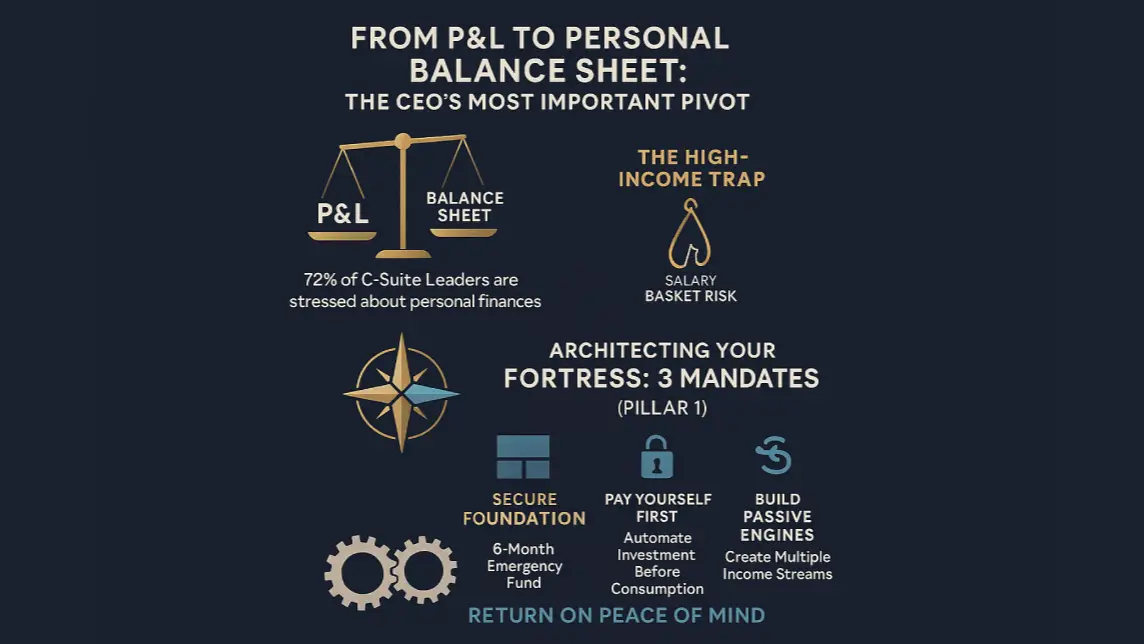
Yet, a deep and troubling paradox exists: despite this mastery of corporate finance, nearly three-quarters (72%) of C-suite leaders report being stressed about their personal finances.
This anxiety isn’t a failure of intelligence; it’s a failure of focus. It stems from the High-Income Trap, where an executive’s success is built upon the fragile foundation of a single salary, while a rapidly expanding lifestyle consumes every gain. The most important financial decision you can make today is shifting your strategic focus: The CEO’s most critical P&L is no longer the company’s—it is your own personal balance sheet.
21. The P&L Delusion: Trading Time for Fragility
For years, your strategy has been simple: maximize active income (the salary). This works brilliantly for the corporate P&L, but it generates extreme personal fragility.
The P&L focuses on yearly performance and cash flow. It encourages a focus on the immediate, active reward. This thinking creates the Salary Basket Risk: your financial stability relies 100% on the continuation of your current employment and active effort. In demanding global markets, where workweeks often stretch past 50 hours, job security is never guaranteed. If that income stream is cut, the entire financial structure—mortgage, lifestyle, and dependents—collapses immediately.
A truly successful leader recognizes that P&L represents current effort, while the Balance Sheet represents lasting freedom. The pivot is acknowledging that you cannot afford to manage personal finances reactively; you must manage them with the same strategic intensity you apply to your corporate holdings.
2. The True North Pivot: Architecting Your Personal Fortress
The shift from managing a corporate P&L to managing a robust personal balance sheet requires an integrated, intentional strategy—the True North framework. This framework demands you become the Architect of your own financial freedom, moving beyond passive reliance on a single paycheck.
The financial pivot is guided by three mandates (Pillar 1):
- Secure Your Foundation: Ensure immediate resilience by establishing a financial safety net—a liquid, accessible Emergency Fund equivalent to six months of expenses. This is the first line of defense against the unexpected.
- Pay Yourself First: Defeat the destructive power of Lifestyle Inflation by automating investments before consumption. This ensures your wealth grows exponentially, rather than being constantly eroded by high living costs.
- Build Passive Engines: Systematically build and optimize multiple income streams that are independent of your salary. This achieves true financial resilience, allowing you to choose when and how you work.
This level of discipline directly counters the Opportunity Cost of Bandwidth—the strategic gap created when you exhaust your mental capacity on corporate issues and neglect to structure your own passive capital.
3. The Integrated Advantage: Clarity and Capital
The pivot is not just financial; it is cognitive. True North success links financial discipline with mental clarity.
When your financial foundation is fragile, it contributes to the chronic stress and burnout that affect over half of leaders. This stress, in turn, compromises your strategic judgment, forcing you into “mindless,” reactive decisions.
By implementing the True North financial strategy, you achieve Return on Peace of Mind. By actively securing your balance sheet, you remove a major source of subconscious anxiety, freeing up the mental bandwidth required to maintain peak cognitive function and deliver clear, composed leadership.
The leader who has mastered their personal balance sheet is the only one truly free to make objective, strategic decisions about their corporate future.
The Call to Action: Become Your Own CEO
You are a CEO every day. It is time to apply that expertise to the one business that matters most: your life.
Your success should be a fortress, providing security and mobility, not a fragile tower trapping you with high expenses.
The transition from a high-income employee to a financially free architect requires intentional action and a holistic strategy. If you are ready to apply strategic clarity to your personal wealth and finally build the resilient life your ambition demands, it is time to chart your True North.
If your financial complexity has outgrown your ability to manage it alone, connect to discuss mapping your True North strategy.