In the relentless pursuit of corporate and personal success, executives meticulously track financial metrics, operational efficiencies, and market share. These tangible assets and liabilities form the familiar balance sheet. But what about the intangible assets that truly drive sustainable high performance and well-being?
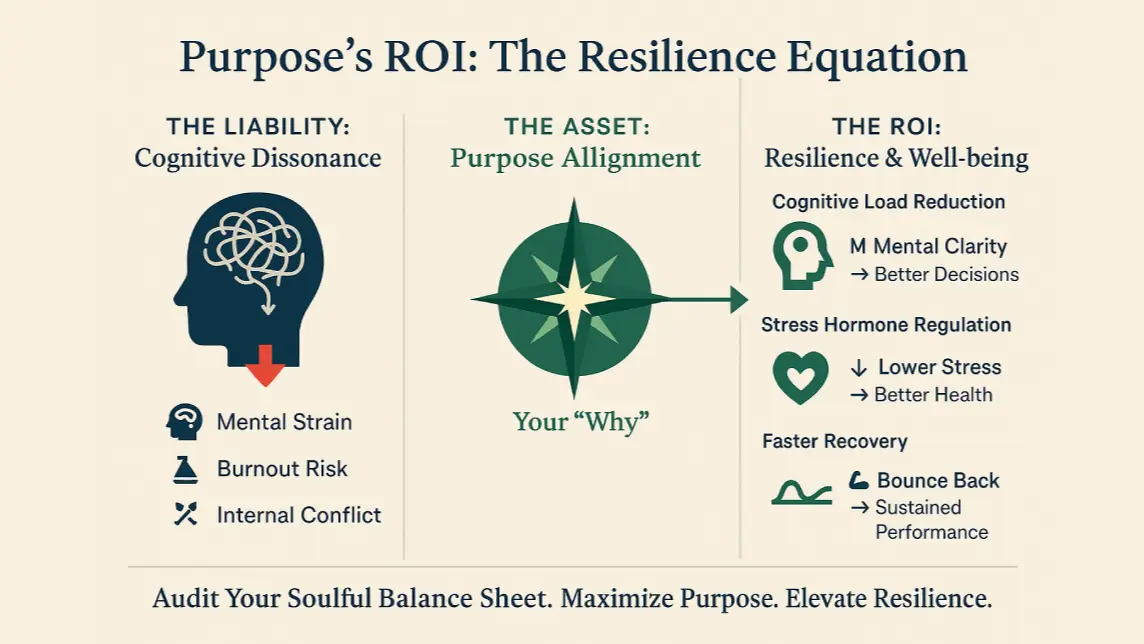
This is where the Soulful Balance Sheet comes into play. It’s an abstract, intellectual framework that posits “Purpose” not as a soft, aspirational ideal, but as a critical, intangible asset with a quantifiable Return on Investment (ROI) directly linked to executive resilience. By living authentically to one’s “True North,” leaders can significantly reduce the cognitive load associated with career dissonance, leading to lower stress hormones and a remarkably faster recovery from setbacks.
Purpose: The Intangible Asset Reducing Cognitive Load
Cognitive load refers to the total amount of mental effort being used in the working memory. In a state of career dissonance—where one’s actions, values, or beliefs in their professional life conflict with their authentic self or deeper purpose—this load becomes exponentially heavier. The brain constantly expends energy to:
- Rationalize incongruence: Justifying actions that don’t align with core values.
- Suppress authentic urges: Ignoring intuition or desires that point to a different path.
- Manage internal conflict: The ongoing mental tug-of-war between “what I should do” and “what feels right.”
This constant mental overhead is a significant liability on the Soulful Balance Sheet. It drains mental resources, leading to:
- Decision Fatigue: A reduced capacity for effective decision-making.
- Reduced Creativity: Mental bandwidth is consumed by internal conflict, not innovation.
- Chronic Stress: The body responds to sustained mental effort and dissonance with physiological stress.
When a leader aligns their career and life with their authentic purpose (their “True North”), they actively reduce this cognitive load. Their brain no longer needs to work overtime to reconcile internal conflicts. Energy is freed up, creating mental spaciousness and efficiency. This reduction in cognitive overhead is the first major ROI of purpose.
The Physiological Dividend: Lower Stress Hormones
The direct link between reduced cognitive load and physiological well-being is profound. When the brain is operating in a state of congruence, the body’s stress response system (the HPA axis) is less frequently activated.
- Cortisol Regulation: Chronic career dissonance keeps cortisol levels elevated. Purpose alignment helps to regulate cortisol and other stress hormones. Lower baseline stress hormone levels mean less systemic inflammation, improved sleep, and a stronger immune system.
- Parasympathetic Dominance: Living with purpose naturally fosters a sense of meaning and control, which encourages the activation of the parasympathetic nervous system—our “rest and digest” mode. This counteracts the “fight or flight” response, promoting deep calm and physiological restoration.
This physiological dividend is a tangible ROI. It translates into greater physical health, sustained energy, and a significant reduction in the hidden costs of chronic stress, such as burnout and illness.
Resilience: The Ultimate Return on Investment
Perhaps the most powerful ROI of purpose on the Soulful Balance Sheet is resilience. Resilience isn’t just bouncing back; it’s the capacity to grow from adversity, to adapt swiftly, and to maintain psychological integrity in the face of setbacks.
When purpose serves as an anchor:
- Faster Recovery from Setbacks: For a purpose-driven leader, a challenge is less likely to trigger an existential crisis. It becomes an obstacle to be navigated on the path to their “Why,” rather than a personal affront. This perspective accelerates recovery and prevents prolonged periods of rumination or despair.
- Enhanced Adaptive Capacity: Purpose provides a stable framework against which new information and challenges can be evaluated. Leaders can adapt strategies and tactics without losing sight of their core mission, fostering true agility.
- Sustained Motivation: Even in the face of failure or intense pressure, a strong sense of purpose acts as an intrinsic motivator, providing the drive to persevere and innovate.
Building Your Soulful Balance Sheet: Auditing for Purpose
To leverage this powerful intangible asset, executives must consciously “audit” their Soulful Balance Sheet:
- Define Your True North: Articulate your core values, your unique strengths, and the profound impact you genuinely wish to make. This is your guiding star.
- Identify Dissonance Debt: Honestly assess areas in your career or leadership style where actions diverge from your stated purpose. This “dissonance debt” is where your cognitive load is highest.
- Invest in Alignment: Strategically adjust roles, projects, or even communication styles to bridge the gap between action and purpose. Prioritize decisions that reduce cognitive load and foster congruence.
- Track the Dividends: Notice the subtle shifts—increased mental clarity, improved sleep, quicker recovery from stress, and a deeper sense of fulfillment. These are the measurable returns on your investment in purpose.
By consciously valuing and cultivating purpose as an intangible asset, leaders not only enhance their own resilience and well-being but also model a sustainable path to high performance, creating a lasting positive impact that truly maximizes long-term value for themselves and those they lead.